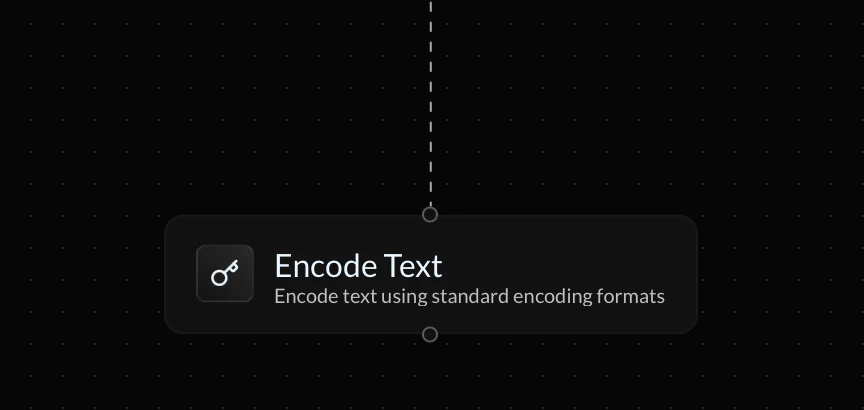
The Encode Text action allows you to encode text into various different formats. Encoding is useful when a service (such as an external API) is only compatible with certain encoding formats.
Screenshot of the Encode Text action block

Input Text

The input text is the base text value that will be encoded. This may be static text or a variable.

Encoding Method

The encoding method is the format of encoding that will be used on your text value. Below are listed the available formats that can be used to encode a text value using the Encode Text action:
FormatDescriptionExample Output
Base64Helps prevent data corruption in JSON, HTTP Headers, etc.SGVsbG8gVGhlcmU=
Base64URLURL-safe version of Base64 that prevents corruption in URLs, query parameters, etc.SGVsbG8gVGhlcmU
HexConverts to hexadecimal with a base-16 format for compacting and safety48656c6c6f205468657265
UTF-8Efficient endocing format used for web services and multilingual compatibilityHello There
ASCIIStandard binary integer used to represent English charactersHello There
BinaryFoundational 2-bit encoding format used at the deepest levels of computing01001000 01100101 01101100 01101100 01101111 00100000 01010100 01101000 01100101 01110010 01100101

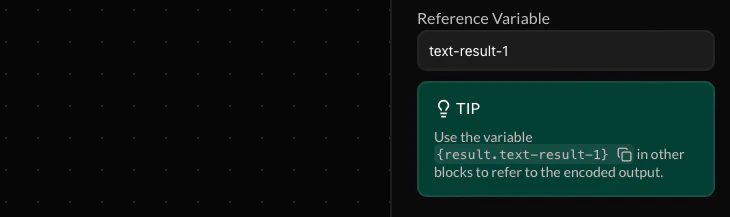
Reference Variable

Screenshot of reference variable settings
This variable allows you to refer to the result of the text encoding in future action blocks down your endpoint’s flow. This variable must be assigned a custom name.
Make your reference variable names as descriptive and unique as possible to prevent your endpoint flow from becoming cluttered. If a future variable is assigned the same name, the value of your reference variable will be overriden.